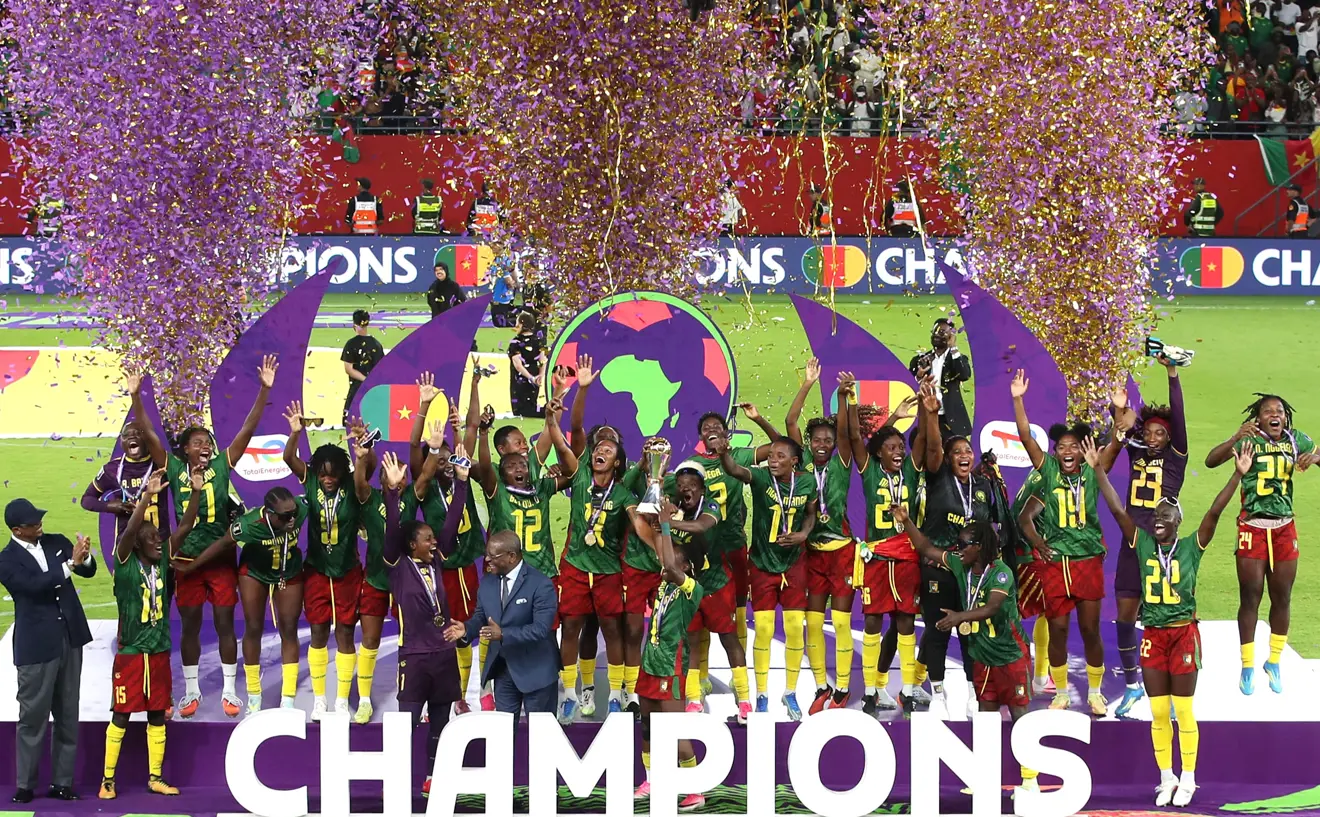
Cameroon are champions of Africa for the first time after Marie Ngah Manga scored twice in a commanding 3-0 victory over Malawi in the 2026 Women’s Africa Cup of Nations final.
Naomi Ndjoah Eto added Cameroon’s second goal and assisted Ngah’s second as the Indomitable Lionesses settled the final during a devastating opening half at the Moulay El Hassan Stadium in Rabat.
Cameroon had lost each of their three previous WAFCON finals, all against Nigeria, without scoring. They ended that painful record emphatically, finding the net three times before half-time and preventing the tournament’s most productive attack from registering a response.
The result completed an extraordinary journey for a team that had not originally qualified for the competition. Cameroon were invited after WAFCON was expanded from 12 to 16 teams, but ultimately finished the tournament unbeaten, eliminated defending champions Nigeria and hosts Morocco, and did not concede a single goal throughout the knockout phase.
WAFCON 2026 Final Result
Cameroon 3-0 Malawi
Goals:
- Marie Ngah Manga — 20’
- Naomi Ndjoah Eto — 30’
- Marie Ngah Manga — 45+3’
Venue: Moulay El Hassan Stadium, Rabat
Date: Sunday, 16 August 2026
Cameroon Decide the Final Before Half-Time
The final brought together two countries attempting to win WAFCON for the first time, but Cameroon handled the occasion with considerably greater authority.
Malawi had scored 12 goals on their way to the final, with Temwa and Tabitha Chawinga driving one of the tournament’s most dangerous attacks. Cameroon’s priority was therefore clear: control the transitions, deny the sisters room to accelerate and force Malawi to attack from less threatening positions. That plan was supported by an early breakthrough.
Ngah opened the scoring in the 20th minute, giving Cameroon the lead and forcing Malawi to pursue the match against the competition’s best-organised knockout defence.
The second goal arrived only 10 minutes later. Myriam Nyadjou created the opportunity for Ndjoah Eto, who finished to put the Indomitable Lionesses firmly in control.
Malawi introduced Tiasha Sani for Chikondi Gondwe in the 43rd minute, attempting to alter the direction of the contest before the interval. Instead, Cameroon struck again.
Ndjoah Eto supplied the pass for Ngah in the third minute of first-half stoppage time, allowing the forward to complete her brace and send Cameroon into the dressing room with a 3-0 advantage. The final had effectively been decided in its opening 48 minutes.
Malawi’s Attack Finally Meets Its Match
Malawi’s debut campaign had been defined by courageous and aggressive attacking football. The Scorchers scored three against Nigeria, three against Egypt and another three in their semi-final victory over Algeria. Temwa Chawinga entered the final with five tournament goals, while Tabitha had scored four.
Cameroon prevented both from adding to those totals. The Indomitable Lionesses protected the central areas, limited the space available for Malawi’s transitions and avoided the defensive disorder upon which the Chawinga sisters had repeatedly capitalised during the tournament.
With a three-goal advantage, Cameroon had no reason to force the second half. They managed possession and territory carefully, remained compact without the ball and refused to give Malawi the early goal that could have revived the contest.
It was not simply a case of defending a lead. Cameroon controlled what kind of match the second half became.
Michaely Bihina Completes Golden Glove Campaign
Cameroon’s title was built on the tournament’s most impressive knockout defensive run, with goalkeeper Michaely Bihina central to it. The 22-year-old completed the final with another clean sheet and was subsequently awarded the WAFCON Golden Glove.
Her most influential performances came before the final. Bihina made nine saves as Cameroon eliminated 10-time champions Nigeria 1-0 in the quarter-finals. She then made three saves across 120 goalless minutes against Morocco before stopping three penalties in the semi-final shootout.
Those displays earned her the Woman of the Match award in both knockout fixtures.
Across the quarter-final, semi-final and final, Cameroon did not concede once. They survived Nigeria’s attacking pressure, resisted Morocco in front of the host crowd and then shut out a Malawi team that had entered the final as the competition’s leading scorers.
Bihina’s Golden Glove was therefore more than an individual reward. It represented the defensive foundation upon which Cameroon built their first title.
Ngah Ends Cameroon’s Final Frustration
Ngah entered the final as Cameroon’s leading scorer with three goals and doubled her tournament total when the trophy was at stake. Her brace was particularly significant because of Cameroon’s history in the competition’s deciding match.
The Indomitable Lionesses lost WAFCON finals to Nigeria in 2004, 2014 and 2016. They did not score in any of those matches. The opening goal in Rabat ended that sequence. The third removed almost any possibility of another final slipping away.
Cameroon became only the fourth country to win the Women’s Africa Cup of Nations, joining Nigeria, Equatorial Guinea and South Africa. Their success also guaranteed a new champion after Cameroon had eliminated holders Nigeria in the quarter-finals.
For captain Gabrielle Aboudi Onguéné and a country that had spent decades pursuing this trophy, the victory closed one of African women’s football’s longest unfinished stories.
From WAFCON Invitation to African Champions
Cameroon’s route to the title was highly unusual. WAFCON 2026 was initially planned as a 12-team competition. CAF subsequently expanded the tournament to 16 nations and invited Cameroon, Côte d’Ivoire, Mali and Egypt based on their FIFA rankings after those countries had failed to qualify through the original process.
Cameroon did not waste the opportunity. They defeated Mali and Ghana before drawing with Cape Verde to finish unbeaten at the top of Group D. Their route through the knockout phase then became progressively more demanding:
- Quarter-final: Cameroon 1-0 Nigeria
- Semi-final: Morocco 0-0 Cameroon — Cameroon won 3-1 on penalties
- Final: Cameroon 3-0 Malawi
Calling Cameroon fortunate to be present would ignore everything they did after arriving. They defeated the defending champions, eliminated the hosts and overwhelmed the tournament’s most prolific team without conceding a knockout goal.
Their invitation opened the door. Their performances explain why they leave Morocco as champions.
Malawi Leave With History of Their Own
The final defeat should not obscure what Malawi accomplished during their first WAFCON appearance.
The Scorchers defeated Nigeria and Egypt, finished top of a group in which three teams collected six points, eliminated Ghana in the quarter-finals and beat Algeria to reach the final. By reaching the semi-finals, they also qualified for the 2027 FIFA Women’s World Cup. Few debutants have made such an immediate impact on the competition.
Temwa and Tabitha Chawinga supplied the star power, but Malawi’s campaign also demonstrated the quality developing around them. Rose Kadzere, Faith Chinzimu and several other players made decisive contributions during a run that changed expectations surrounding the national team.
Malawi finished as runners-up and will receive $750,000 in prize money. Cameroon collect the trophy and the $2 million champions’ award.
Cameroon Complete an Unbeaten WAFCON Campaign
Cameroon’s final tournament record reads:
- Played: 6
- Won: 4
- Drawn: 2
- Goals scored: 8
- Goals conceded: 2
- Knockout goals conceded: 0
Their campaign contained different versions of the same strength. They were disciplined enough to survive Nigeria, patient enough to outlast Morocco and ruthless enough to decide the final before half-time.
The expansion of WAFCON gave Cameroon a route into the tournament that did not previously exist. What followed was entirely their own work.
From invited participants to unbeaten African champions, the Indomitable Lionesses turned an unexpected opportunity into the first WAFCON title in their history.
Source: CAF


Leave a Reply