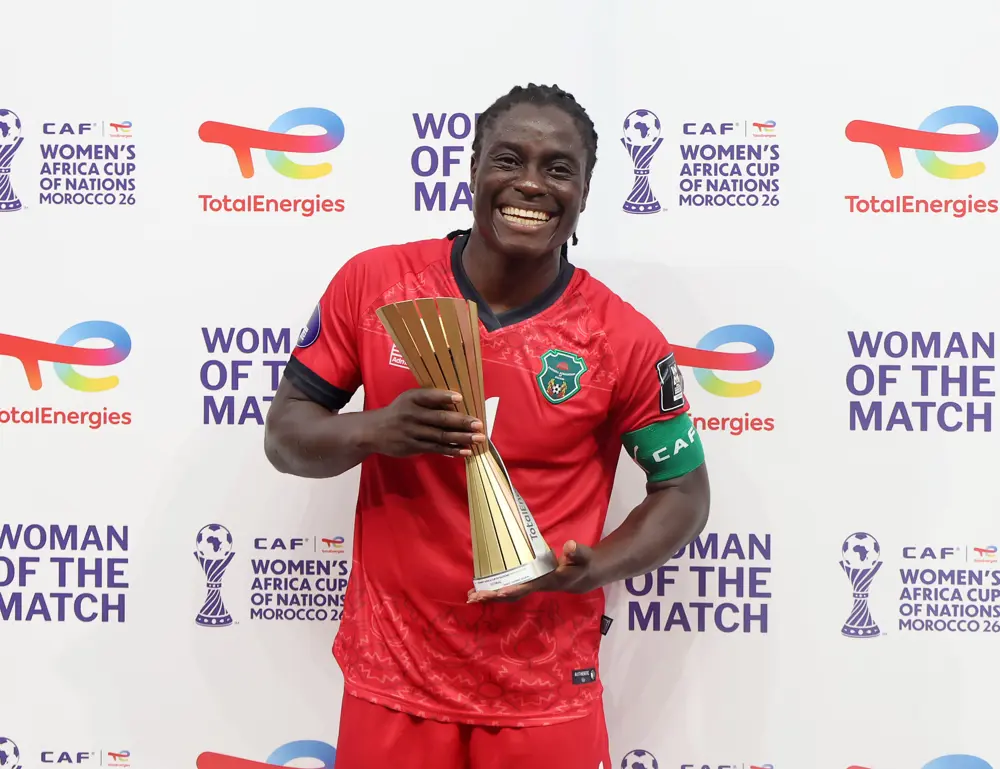
Malawi have reached the 2026 Women’s Africa Cup of Nations final after defeating ten-player Algeria 3-1 in Rabat. Tabitha Chawinga scored twice and Temwa Chawinga added Malawi’s second as the WAFCON tournament debutants continued a campaign that has already secured their first qualification for the FIFA Women’s World Cup.
Algeria played for more than an hour with ten players following Morgane Belkhiter’s direct red card in the 23rd minute. Yet the final score does not tell the full story of a competitive semi-final in which the North Africans registered nine shots on target to Malawi’s seven.
Ikram Adjabi reduced Algeria’s deficit during the second half, but Tabitha’s second goal ended their pursuit of an equaliser and confirmed Malawi’s place in the continental final on 16 August.
Match Snapshot
- Result: Algeria 1–3 Malawi
- Algeria scorer: Ikram Adjabi, 60’
- Malawi scorers: Tabitha Chawinga, 34’ and 77’; Temwa Chawinga, 45+1’
- Red card: Morgane Belkhiter, 23’
- Possession: Algeria 52%–48% Malawi
- Shots on target: Algeria 9–7 Malawi
- Standout player: Tabitha Chawinga
Belkhiter’s Red Card Changes the Semi-Final
The first major turning point arrived before either team had scored. Belkhiter received a direct red card in the 23rd minute, leaving Algeria to contest the remainder of their first WAFCON semi-final with ten players.
Malawi did not score immediately, but the dismissal created more space for their forwards and placed greater physical demands on an Algerian defence that had built its tournament around organisation.
The breakthrough followed in the 34th minute. Asimenye Simwaka supplied the ball for Tabitha Chawinga, who improvised brilliantly to send an acrobatic effort against the crossbar and into the net. It was a finish suited to the occasion, combining the captain’s instinct with the technical quality needed to execute an unconventional chance.
Temwa Strikes Before the Break
Algeria needed to reach half-time without sustaining further damage. Malawi instead doubled their advantage in the first minute of added time. Faith Chinzimu played Temwa Chawinga through, and the forward remained composed as she rounded the goalkeeper and finished into the empty net.
The goal reflected the relationship between Malawi’s established stars and the younger players supporting them. Chinzimu, one of the midfielders behind the Scorchers’ rise through qualification, supplied the pass; Temwa turned it into a two-goal half-time lead. Both Chawinga sisters had now scored in the most important match Malawi had ever played.
Algeria Refuse to Disappear
The numerical disadvantage did not stop Algeria from competing. Farid Benstiti’s side held 52 per cent of possession and continually tested Malawi’s defence, eventually recording more shots on target than the Scorchers.
Their pressure produced a reward in the 60th minute. Marine Dafeur’s dangerous free-kick caused uncertainty inside the penalty area, allowing Adjabi to react to the loose ball and volley home.
At 2-1, the semi-final was open again. Malawi could no longer rely on their numerical superiority to control the contest. Algeria had shown throughout the tournament that they could remain disciplined under pressure, and their goal gave them renewed belief.
Their nine efforts on target illustrate how much work Malawi still had to do after building the commanding first-half lead.
Tabitha Chawinga Ends Algeria’s Comeback
With Algeria pushing for an equaliser, Malawi needed a player capable of changing the direction of the match. Tabitha delivered again in the 77th minute.
The captain beat her marker before driving a left-footed finish into the net. No assist was officially recorded, fitting for a goal created through her own ability to overcome the defender and finish the move.
Her second goal restored Malawi’s two-goal cushion just as Algeria were threatening to turn the semi-final into a far more difficult closing period.
Algeria still refused to concede the contest. Laura Muller rounded the goalkeeper in the 87th minute, but her hesitation allowed Malawi’s recovering defenders to intervene.
That clearance preserved the 3-1 advantage and ensured the final minutes could not undo the work Malawi had completed across the match.
Tabitha Delivers as Captain
Temwa entered the semi-final as one of WAFCON’s most dangerous attackers, but Tabitha produced the decisive individual performance.
Her opening goal settled Malawi after the red card without allowing the occasion to become tense. Her second arrived when Algeria had recovered momentum and were searching for an equaliser.
The two finishes required different qualities: improvisation for the first and directness for the second. Together, they demonstrated why Tabitha’s importance extends beyond wearing the captain’s armband.
She has won major honours at club level, while Temwa has established herself among the leading forwards in the NWSL. Their success has long represented what Malawian players could achieve elsewhere.
At WAFCON, they are now directing that experience towards their own national team.
Malawi Are More Than a Tournament Surprise
Malawi began the competition by beating defending champions Nigeria. They followed that result with victory over Egypt, topped Group C and then eliminated Ghana in the quarter-finals.
Every stage presented a reason to expect their run to end. It has continued because Malawi have repeatedly produced the required response.
Against Ghana, Rose Kadzere scored the winner. Chinzimu contributed to the qualification campaign and assisted Temwa in the semi-final. Simwaka created Tabitha’s opening goal against Algeria.
The Chawinga sisters provide the elite quality, but Malawi’s supporting players have prevented opponents from solving the team simply by concentrating on its two biggest names.
Their semi-final performance added another quality: efficiency under pressure. Algeria had more possession and placed nine attempts on target, but Malawi converted three of their seven.
One Match From the African Title
Malawi entered WAFCON 2026 without ever appearing at the continental finals. They will leave as World Cup qualifiers and, at worst, African runners-up. The final will be played on Sunday, 16 August, with Malawi’s opponent to be confirmed.
Their campaign has already transformed the country’s women’s football history. Yet reaching the final changes the nature of the story once more.
The Scorchers are no longer playing only to extend an extraordinary debut. They are one victory from becoming African champions.
Source: CAF

Leave a Reply